
Designing HVAC for a Hi-Fi Listening Room Built Around $750,000 in Speakers
Apr 06, 2026Why HVAC Is a Sound Isolation Problem — Not a Comfort Problem
A look inside the HVAC design for a high-performance Hi-Fi listening room built around one of the most extraordinary speaker systems in North America.
Most HVAC contractors think about two things: keeping the room comfortable and hitting the required airflow numbers. In a standard build, that is enough. In a high-performance sound isolated space, it is nowhere close.
We are currently designing a Hi-Fi listening room for a client who has invested in one of the most extraordinary speaker systems in North America. The room has to be worthy of that investment. That means the HVAC system cannot simply condition the air. It has to do so without introducing a single decibel of mechanical noise into a space engineered for near-perfect acoustic silence.
When the listening floor of a room is that low, you hear everything the system does. Every duct resonance. Every register whistle. Every cubic foot per minute of air moving creating a face velocity that is a fraction too high. None of that is acceptable when the room exists to reveal exactly what those speakers are capable of.
This article walks through how we approached the HVAC design for this project, why the decisions we made were non-negotiable, and what it actually takes to coordinate a system like this across an architect, a structural engineer, an HVAC technician, and a builder simultaneously.
The Real Challenge Is Not the Math. It Is the Coordination.
Before we ran a single calculation on this project, we had to establish something more fundamental: who on this team was responsible for what, and how were the decisions going to flow between them.
A sound isolated room of this caliber does not get built by one contractor working from a single set of plans. It gets built by multiple specialists who each own their piece of the system, and whose work has to interlock precisely. The HVAC design sits at the intersection of almost every one of those systems. Get it wrong and the acoustic isolation fails. Get it right and the room performs at a level most builders have never attempted.
On this project our coordination involved five parties: the architect, the structural engineer, the HVAC technician, the builder, and the client. Every HVAC decision we made had downstream consequences for at least two of them. None of those conversations happened on site. They happened in the design documents, which is exactly how it should work.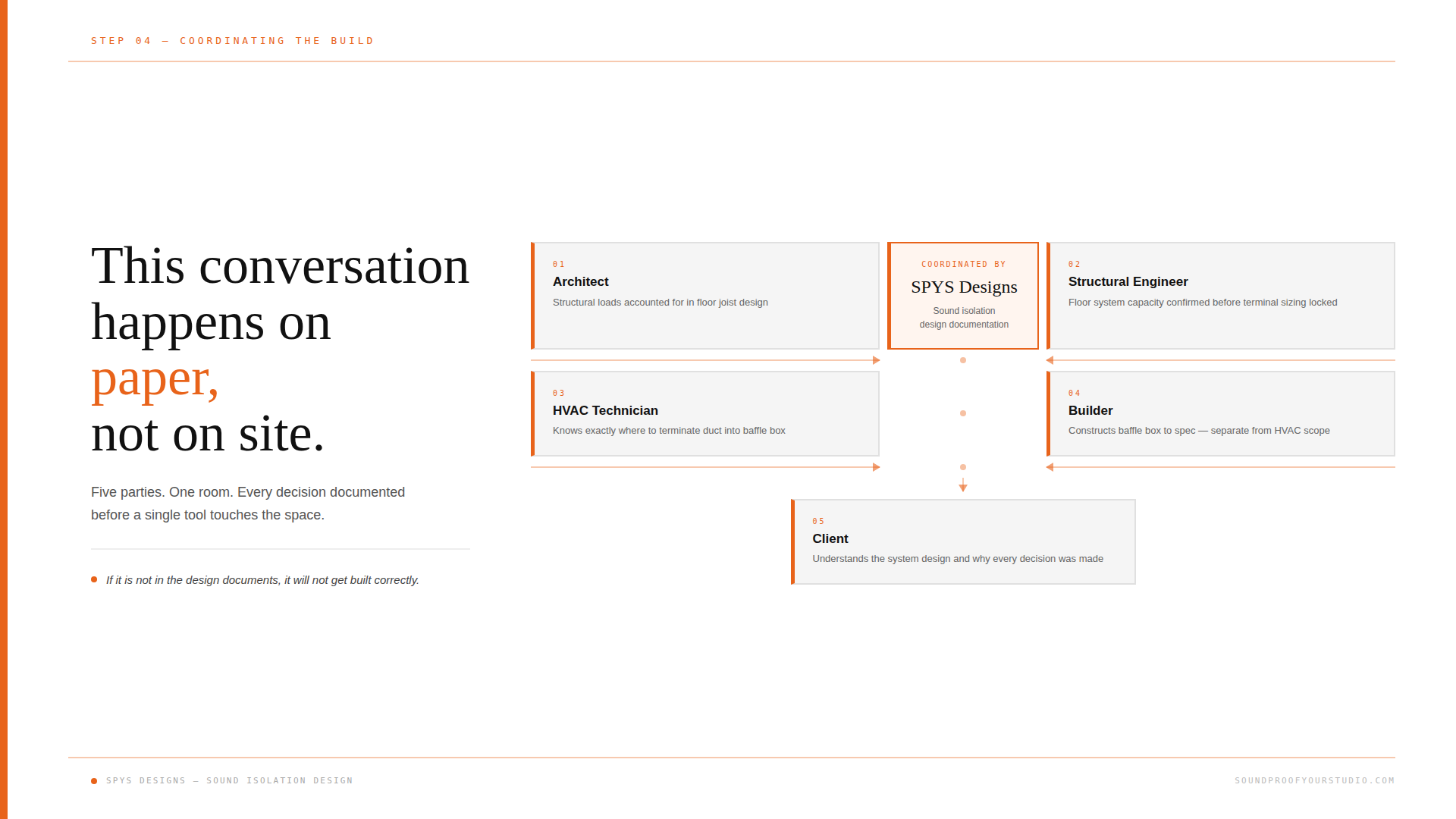
Step One: Understanding What the Room Actually Needs
The starting point for any HVAC design is the total CFM the room requires. CFM — cubic feet per minute — is the volume of conditioned air the system has to move to maintain the space at temperature. Every decision downstream flows from that number.
We do not run this calculation ourselves. We direct the client's HVAC team to perform a Manual J load calculation and a Manual D duct design. Manual J tells us the room's heating and cooling load based on its thermal envelope. Manual D gives us the duct layout and sizing to distribute that air efficiently.
This is the first example of the coordination model in practice. We identified what we needed, specified the standard it had to meet, and handed the execution to the specialist whose domain it is. The HVAC team delivered the numbers. We took those numbers and built the acoustic system around them.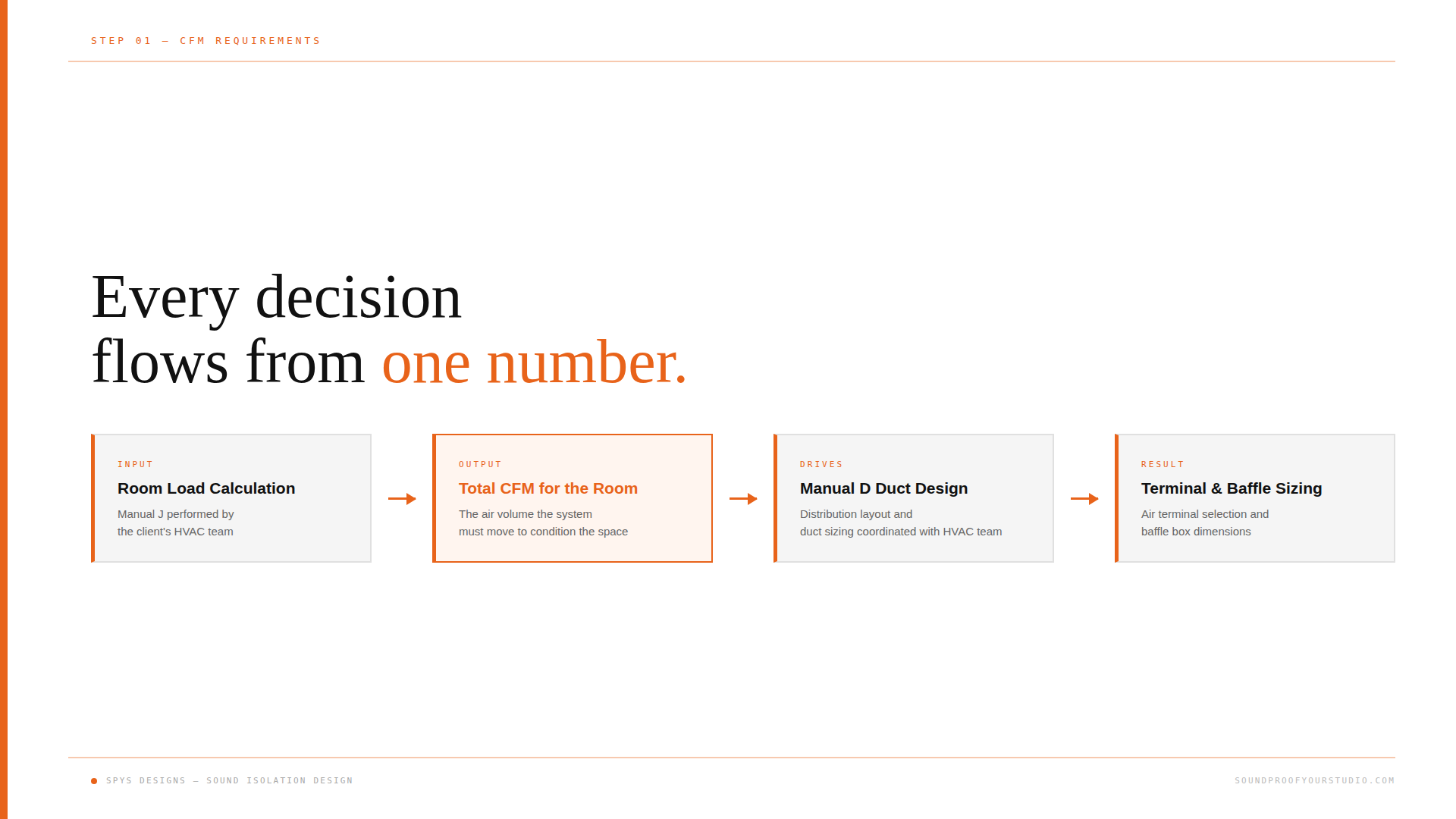
Step Two: Sizing the Air Terminals for Acoustic Performance
Once we have the total CFM, we size both the supply and return air terminals. The sizing criteria in a standard build is straightforward: move the required air through an appropriately sized opening. In a sound isolated room, there is a second variable that governs every decision — face velocity.
Face velocity is the speed at which air moves across the face of the terminal as it enters or exits the room. When that velocity is too high, the movement of air becomes audible. In a listening room engineered around a $750,000 speaker system, audible airflow is an unacceptable failure.
We use engineering data from our suppliers to determine the maximum face velocity that remains below the audibility threshold for each specific terminal in each specific position in the room. We then size the terminals to keep the system within that range under full airflow conditions. The calculation tells us exactly what the terminal needs to be. We do not estimate.
On this project, the structural system created an additional constraint. The flooring assembly — engineered for the mass and decoupling requirements of a room performing at this level — compressed the available space between floor joists. We had to confirm with the structural engineer that our terminal sizing could accommodate the available void before we could finalize the design. That confirmation required a coordination step most HVAC projects never take.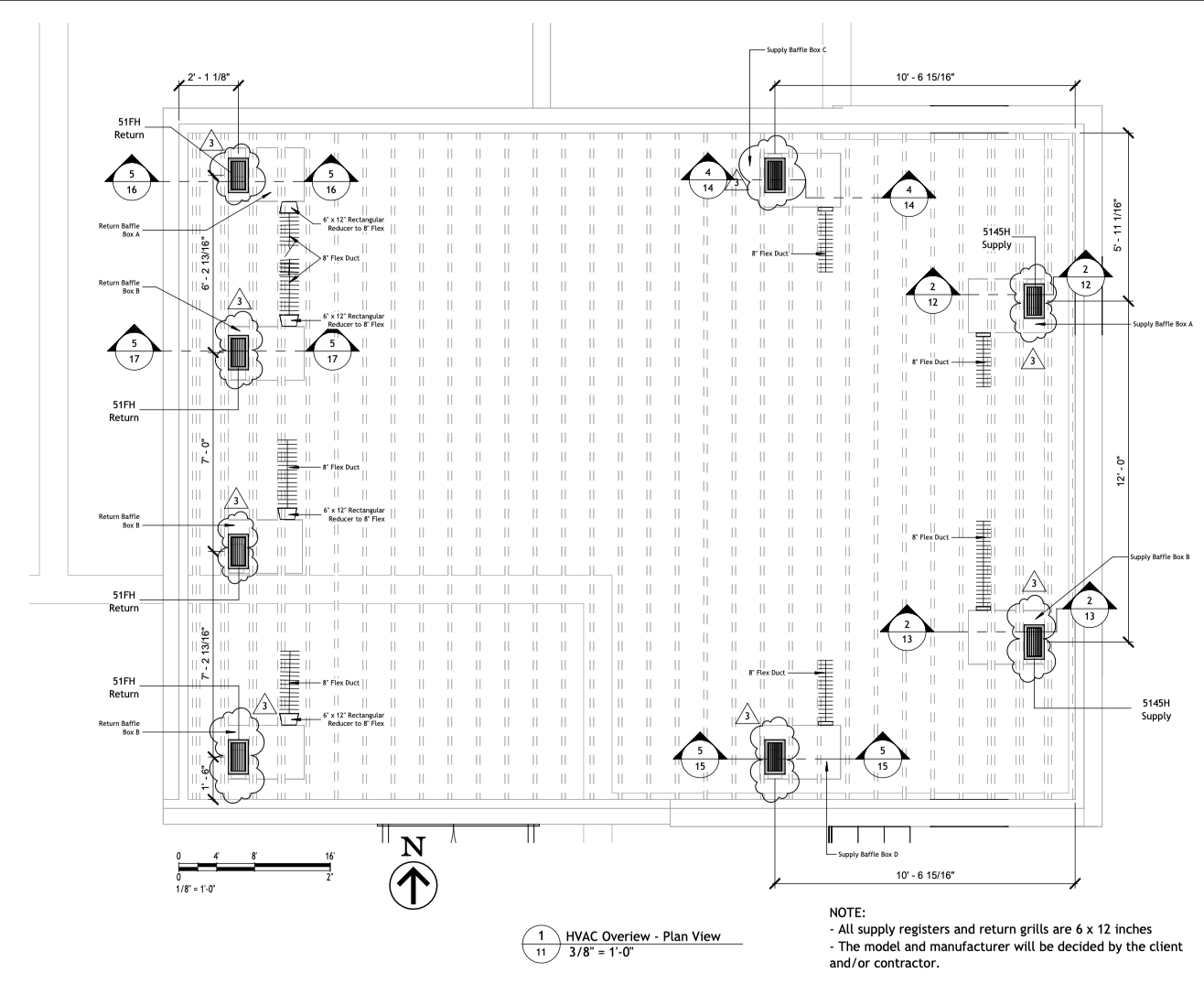
Step Three: The Baffle Box System
Every duct penetration into a sound isolated room is a potential failure point. The assembly of decoupled walls, resilient ceiling, and acoustic floor that we engineer so carefully to block sound transmission can be completely undermined by a single unlined duct opening that connects the isolated space to the rest of the building.
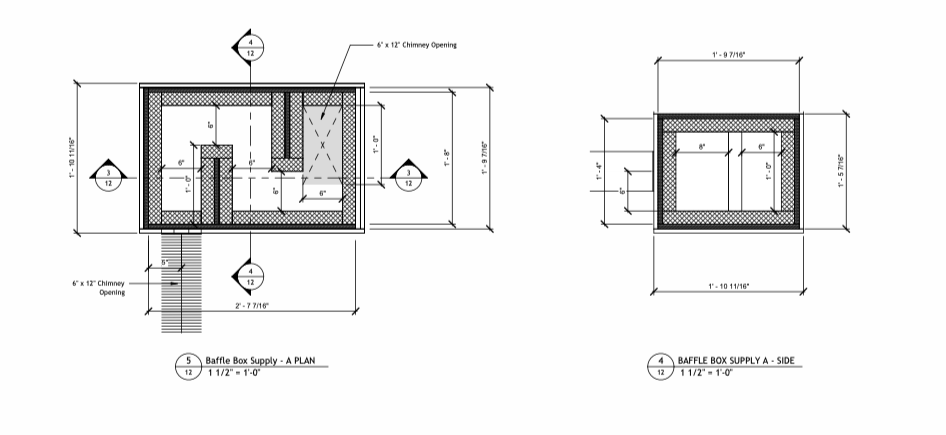
The baffle box is how we solve this problem. It is a lined enclosure that sits between the duct system and the air terminal — a transition chamber that allows conditioned air to pass through while eliminating the direct acoustic path between the outside environment and the isolated room.
We size the baffle boxes based on the face velocity calculation and line them with acoustic liner selected to absorb as far down into the lower frequencies as the geometry allows. The result is a system where air enters and exits the room without carrying sound in either direction through the duct penetration.
What most people do not realize is that the HVAC technician does not build the baffle boxes. That is the builder's scope. The HVAC team terminates their duct at the baffle box entry point. The builder constructs the box around it according to our specifications. Two separate scopes, two separate parties, one integrated system. If that handoff is not clearly documented, it does not happen correctly.
Step Four: Communicating the System to the Team
The most technically precise design in the world fails if the people building it do not understand what they are building or why. Our job does not end when the documents are finished. It ends when every party on the project has a clear, unambiguous set of instructions that tells them exactly what to do within their scope.
On this project that meant the HVAC technician knew exactly where to terminate the duct and at what dimension. The builder had a detailed specification for the baffle box construction sequence. The architect had confirmed the structural loading from our flooring assembly before we finalized terminal sizing. The client understood the reasoning behind every decision we made.
None of that coordination happened on site. It happened in the design documents. When the contractor shows up to build, the decisions are already made. The documents are the system. That is the entire point of what we produce at SPYS Designs.
What This Means for Your Project
If you are planning a high-performance listening room, a professional recording space, or any room where acoustic performance is a non-negotiable specification, the HVAC system is part of the design from the first conversation. It is not a trade you hand off to a mechanical contractor and revisit at rough-in. It is an acoustic system that happens to condition air.
The gap between a room that performs and one that does not is rarely the speaker system or the acoustic treatment. It is almost always a decision that was made too late — or not documented carefully enough to survive the transition from design to construction.
That gap is what we close.
Start With Your Site
If you are in the early stages of planning a sound isolated space, the first step is understanding what your site can actually support. Our Sound Isolation Site Assessment takes five minutes and gives you a clear read on your site before you spend a dollar on design or construction.
Sound Isolation Site Assessment
Wilson Harwood | Sound Isolation Designer & Principal, SPYS Designs
SPYS Designs engineers sound isolated rooms for residential and commercial clients across North America.
Are you ready to move from planning to building?
Book a Soundproof Planning Call to determine whether your studio is feasible, what it will realistically cost, and what path makes sense for your space.
